A psychologist’s reflection on shedding emotional weight and conserving energy at the end of a hard year.
Hello, fellow travelers.
As many of you know, I am not a fan of New Year’s resolutions. Instead, I gravitate toward intention words or phrases that help us focus our time, attention, and energy as one year closes and another begins.
Some years, we embrace our intention word(s) with gratitude and enthusiasm. Other years, it’s harder to find that energy. We feel more like a burro carrying far too much weight for its back to hold, focused on staying upright rather than looking ahead.
This blog is for those of us who need to release before we reach.
Dear Jennifer,
This year was awful. Political drama, relationship drama, burnout at work, financial stress. By the time the holidays rolled around, I was exhausted and had nothing left to give. I’m so tired of being scared that I am one small step away from having everything fall apart.
What helps when you’re emotionally exhausted and overwhelmed?
Tired and Depleted
Dear Tired and Depleted,
Ay, fellow traveler, I hear you.
Yesterday, as I drove home from my family’s holiday celebration, I found myself reflecting on how demanding this year has been and how weary the idea of limping into a new year makes me feel.
Emotional exhaustion has a way of shrinking our sense of safety until everything feels fragile—like one misstep could undo us.
As the calendar year closes, we are also approaching the end of the Year of the Wood Snake in the Chinese Zodiac. This year has been associated with growth, adaptation, and renewal—the snake’s ability to shed its skin paired with wood’s flexibility and resilience. In other words, it was a year that quietly demanded we outgrow old ways of being.
What we often forget is that growth is rarely comfortable. Before a caterpillar becomes a butterfly, it passes through a cocoon filled with unfamiliar, disorienting change. A hermit crab molts, sheds its exoskeleton, seeks a new shell, and the process begins again.
Renewal almost always asks something of us first. It begins with the awareness that we have outgrown our current casings.
That brings me to a story, a revised version of one I shared previously.
The Snake on the Porch
A Story & Reflection About Shedding
I’m sitting on my front porch when a snake slithers into view. My body tenses. My heart races. I can feel every muscle waiting for my brain to decide: fight, flee, or freeze?
The snake stops and looks at me.
“Why do you move away?” it asks.
“I’m scared of you.”
“Why?”
“Because you could hurt me.”
“I could,” it says. “But I haven’t.”
I nod. “Yes.”
“What could I do to earn your trust?”
“Promise you won’t hurt me.”
The snake shakes its head.
“I can’t promise that. I don’t make guarantees. I’m a teacher.”
He gestures toward a discarded snakeskin nearby.
“That was mine—until it was time to move on. You humans don’t shed. You get comfortable in your skin and forget that life is about outgrowing what once fit you well.”
I exhale. “Why would I want to outgrow something that feels comfortable?”
“Because you were meant for more than staying on your porch, wearing a life you’ve outgrown.”
Tears well in my eyes. “Is it scary to shed your skin?”
“Always,” he says. “It feels vulnerable and uneasy—but remaining in a skin that no longer fits is far more painful than letting it go.”
I smile. “I’m not scared of you anymore.”
“Good,” the snake says. “Are you scared to leave your porch?”
I shake my head, stand, and take a step forward.
“What will you do now?”
“I’m not sure yet.”
“That,” he replies, “sounds like an excellent place to begin.”
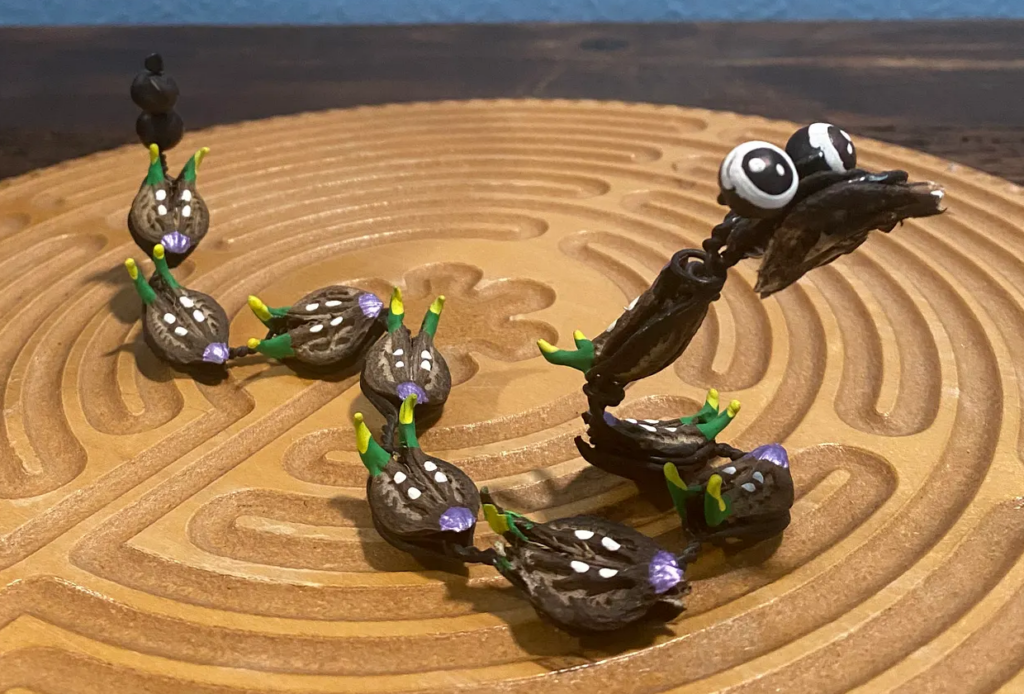
I once wandered into a favorite Austin shop, where I noticed small handmade snake figurines crafted from seed pods and wire.
I’d always avoided snakes—raised on warnings about copperheads and rattlesnakes—but I couldn’t stop glancing back at them. After the third pass, I finally stopped to read the card beside them. I don’t remember the exact wording, but the message stayed with me:
Snakes remind us to reinvent ourselves, to shed what we’ve outgrown, and to release what no longer serves us.
Depending on age, habitat, and environment, a snake sheds its skin several times a year.
As I looked at the snakes, questions arose.
What might our lives look like if we shed the emotional armor we wear to stay safe?
What adventures might call to us?
What new people might expand our world?
Who could we become if we treated change as a natural part of living instead of something to fear?
I bought one of those seed-pod snakes. It now sits on a shelf in my therapy room, reminding me to loosen my grip on comfort and breathe deeply as I reach toward what’s next.
Originally published as The Snake (Ayres, 2023).
Applying This to You, Tired and Depleted
It sounds, fellow traveler, like this year required a tremendous amount of adaptation. You are not alone in that experience.
As we release this year and approach the close of the Year of the Wood Snake, you might consider not what you want to add in the upcoming year—but what you’re ready to shed.
Research consistently shows that traditional New Year’s resolutions are rarely effective. They begin with enthusiasm and dedication, then quietly dissolve as motivation wanes. Too often, they frame our struggles as problems to be fixed by willpower and self-discipline rather than signals that our current coping strategies are overwhelmed.
So, let’s try something different.
Instead of asking, What will I do differently next year?
Consider asking, What am I unwilling to carry into next year?
The Energy Shed Exercise
You don’t need to do all of this at once. Take your time with Step 2. Even identifying one energy shed is enough for Step 3.
Step 1: Gather Your Supplies
Grab a journal, a blank sheet of paper, or a fresh document. If you use Energy Buddies* (or something similar) to track how you invest your time and attention, have those nearby.
Step 2: Ask Yourself Two Questions
- When you think about this past year, where did your energy go?
- Where did you lose time, attention, or emotional energy that could have been invested more wisely and intentionally?
Common themes often include:
- Worrying about other people’s reactions after making self-care decisions
- Living within a schedule that leaves little room for rest or recovery
- Investing in relationships that feel misaligned with core values
Step 3: Identify Your Energy Sheds (What You’re Ready to Release) and Shifts That Support Letting Go
Energy Shed 1: Worrying About Others’ Reactions to Self-Care Decisions
Thought shifts
- I have the right to choose what is best for me.
- I do not need permission or validation to care for myself.
- I deserve and am worthy of self-care.
Behavior shifts
- Communicate self-care decisions that may be poorly received via text or email, with an invitation to talk later. Written communication can reduce emotional pressure and help you stay aligned with your needs.
- Schedule self-care activities (rest, hobbies, exercise, cooking) as you would any other important commitment.
Energy Shed 2: Guilt About Limited Time and Energy/Overextending
Thought shifts
- There are only so many waking hours in a week.
- Time management is a prioritization strategy, not a moral failing.
- I deserve to give my mind and body time to rest and recover.
Behavior shifts
- Schedule regular check-ins with loved ones (weekly, biweekly, or monthly).
- Schedule downtime intentionally.
- Refrain from accepting commitments until you have evaluated whether they fit into your life without compromising rest or increasing stress.
Energy Shed 3: Draining or Unhealthy Relationship Dynamics
Thought shifts
- As we grow, what we need from relationships changes.
- Over time, healthy relationships generally leave us feeling more grounded, hopeful, or supported.
- I deserve to feel accepted, respected, and valued in my relationships.
- I have the right to self-advocate for my needs.
Behavior shifts
- Prioritize time spent with people who inspire growth and self-compassion.
- When contact with draining relationships is unavoidable, set clear limits—on time, topics, or emotional investment.
Closing Reflection
Fellow travelers, this has been a demanding year. When headlines are filled with fear and anger, it is easy to lose sight of hope and overlook quiet acts of care and courage.
As Jane Goodall once said, it is not hope’s job to find us.
It is our job to walk toward hope.
That walk may feel a little lighter if we release some of the burden we carry.
Ubuntu, fellow travelers.
Jennifer
P.S. Stay tuned for a follow-up exploring how we prepare for the Year of the Fire Horse.
* Energy Buddies were introduced in an earlier blog that explored intentional strategies to manage our time, attention, and energy. Interested in learning more? Check it out.
The snake story and reflection were originally published on Still River Counseling’s Substack page.
© 2025 Jennifer Ayres, PhD | Still River Counseling, PLLC
Written with care for fellow travelers navigating life’s changing currents.
🌐 StillRiverCounseling.com | 📍 Austin, TX
Gentle Reminder:
The reflections shared here are intended to offer insight and support. They are not a substitute for therapy or professional mental-health care, and reading this blog does not create a therapeutic or doctor–patient relationship.