The holidays invite us to reflect on our connections with those who matter most. When we are grieving, that loss often feels sharper in a season filled with messages of joy and festivity. For parents helping children navigate their own grief while carrying their own pain, the holidays can feel especially heavy.
The original letter that inspired the series…
Dear Jennifer,
I’m not sure what I want to do for the holidays. I don’t want to deal with the stress that the holidays bring. Any suggestions about how to handle the dread I feel about going through with family events and then emerging in January feeling broke, exhausted, and disappointed?
— Holiday Hassled
Dear Holiday Hassled,
Let’s take a moment to recap what we have covered so far. In Part 1, we met Megan, a 35-year-old woman facing her first holiday season after divorce and the sudden death of her father. We explored self-compassionate boundary-setting and strategies to manage stress as she stepped into her new role as a single mother.
In Part 2, we turned to Megan’s grief—how the loss of her marriage and her father’s death created waves of sadness, anger, and longing that made the holidays feel even heavier. Together, we explored ways to name and honor those feelings, normalize the messy emotions of grief, and lean into self-compassion instead of self-criticism.
Now, Megan faces a new challenge: supporting her children through their grief while navigating her own pain.
Perhaps, Holiday Hassled, you are not a parent right now. But do you know someone who is struggling? Or do certain losses in your life trigger that young child tucked inside your heart—still holding feelings bigger than it seems possible to carry?
Read on, fellow travelers.
A Family Story: Nala and the Ofrenda

When my sons were three, we adopted a senior cocker spaniel named Nala. Our beloved cocker spaniel, Izzy, had died suddenly a few months before, and we missed having dog energy in our home.
Nala was calming, affectionate, and quickly became part of our family. She tolerated little boy energy, loved us through hard times and celebrated the good ones in the five years she lived with us.
Her death, later diagnosed as cancer, was not unexpected—she was already nine when we adopted her. Still, in mid-October 2018 when we found ourselves living without her gentle spirit, the sadness was sharp. It was the boys’ first real experience with grief. At eight years old, they understood that Nala would never greet us at the door again, never curl up beside us for movie night, never nuzzle us with her cold nose. She was gone and our hearts ached.
That year we created a new tradition inspired by one of our favorite movies, Coco. We built our first ofrenda—a Día de Muertos tradition that honors the idea that our loved ones never truly leave us. Each year, they return to remind us of the bonds of love that remain, even as we live with missing them. We decorated it with photos of my grandparents, my sweet friends Tamara and Billy, and our dogs who had passed away: Izzy, Allie, and Cassidy. The boys added their own treasures each day: toy cars, drawings, even a bowl of Goldfish crackers. (Fellow travelers, I suspect that Maui — not Nala’s spiritual version — was the four-legged creature who enjoyed those, but the mystery remains. Nala did enjoy Goldfish.)
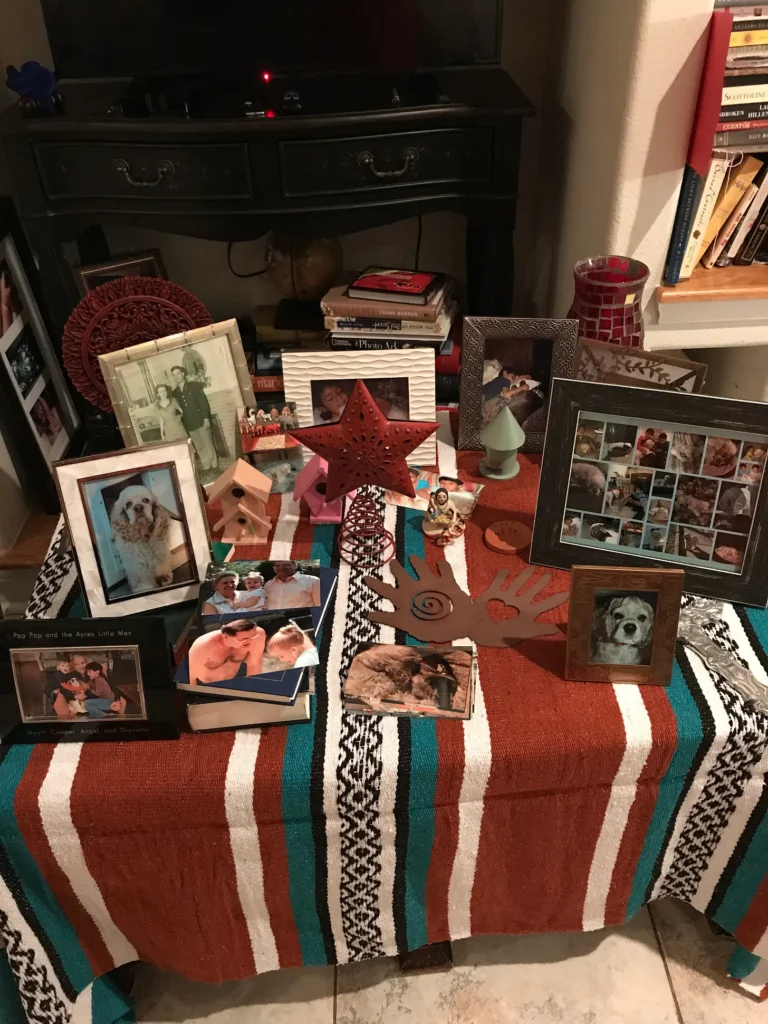
It was perfectly imperfect. And it became the beginning of an annual family ritual to honor those we miss—those with two legs, four legs, and even a few who had fins.
A Child-Friendly Way to Talk About Grief
Before offering strategies of coping with loss and emotional pain, let’s talk about how to explain the complexity of grief to a child or teenager who is hurting. Here is the metaphor I use.

Grief is like a tangled ball of holiday lights (or charger cords or chain jewelry).
- Each cord represents a different feeling: sadness, anger, fear, guilt, jealousy – but also love, gratitude and happiness.
- The messy ball is heavy to hold in our hearts and minds.
- At first, it feels overwhelming, even crushing. But over time, it usually becomes lighter and easier to carry.*
Three truths to remember while holding the grief ball:
It won’t feel this heavy forever.
It isn’t fun and leaves little room for the things we want to hold.
We don’t like how it feels while we carry it.
Footnote: Some people experience grief so crushing that it overwhelms their spirit and hope. If you or your child are struggling in that way, please know you are not alone and that professional support can help lighten the load. Reach out if you need help finding someone.
Family Conversations to Support Grieving Children
Once everyone understands that grief feels different for each person, it can help to talk together about what this season might bring. Before brainstorming holiday strategies, have an open family conversation.
Here are some starting points:
- What does grief look like? Like fingerprints, each person’s grief is unique. Some cry often, some get irritable, others appear “fine.” There’s no right or wrong way to hold the grief ball.
- Normalize big emotions. The grief ball can make feelings rise quickly and hard to manage. Commit as a family to offer each other grace when emotions run high—even when they’re expressed imperfectly.
- Clarify roles. Our job is to love and support one another—not to “fix” feelings or “make it better.” Parents*, it’s okay for kids to see your sadness. With rare exceptions, showing your grief—even imperfectly—does not cause harm. It models honesty, resilience, and the truth that love, loss, and imperfection often walk hand in hand.
- Give children something to do. When kids see a parent sad, they often feel responsible to make things better. Offering small “jobs” allows them to feel helpful without carrying your grief. Examples: offering a hug, drawing a picture, or sitting quietly together.
- Remind children (and their grown-ups) that joy is allowed. Laughing, playing, and having fun do not mean we loved the person any less.
*For the sake of brevity, “parents” in this blog refers to adult caregivers or support system members of any type—biological, adoptive, step, grandparent, guardian, or chosen family.
Brainstorming New Traditions
- Make a list together. Write down everyday and holiday-specific traditions that might feel harder this year. Include big things (Granddad’s empty chair) and small triggers (seeing someone sit in that chair). Keep it as a living document that family members can add to as new thoughts emerge.
- Explore options. Decide together: Which traditions should continue, which might change, and which may pause this year?
- Megan’s children chose to continue their Christmas Eve light drive with her instead of Granddad. Afterwards, they added a toast over mugs of cocoa and marshmallows and shared memories of him before watching A Charlie Brown Christmas (Granddad’s favorite holiday movie).
- Designate a quiet space. Create a spot at home for drawing, journaling, or letter-writing when the grief ball feels heavy. A simple “feelings jar” can give children (and adults) a way to share thoughts and emotions that are hard to speak aloud.
Parents, a Few Things to Remember
- Different adult perspectives about holiday plans are normal. Some relatives may cling to old traditions while others avoid them entirely. Choose the self-compassionate option that feels right for you and your family.
- Your house, your rules. Prepare your children for the reality that other homes may grieve differently—and that’s okay. Give yourselves permission to step away or leave early if needed.
- Your grief ball grows heavier when your children’s and loved ones’ needs are added to it. It’s normal to feel stressed or overwhelmed while trying to hold it all. Identify supportive people—friends who will answer the phone, send a kind text, or remind you that you don’t have to carry the weight alone.
- Grief is a tricky guest. Sometimes it’s predictable; sometimes it arrives unannounced. Rarely does it come at a good time, and it often overstays its welcome. Over time, you’ll recognize its patterns. Meet it with self-compassion when it appears.
- The first year is typically the hardest. Later holidays may still be painful, but the grief ball rarely feels as heavy as it does during that first season.
A Self-Compassion Practice for Parents
When you catch yourself second-guessing or regretting how you handled a moment, pause and follow these steps:
1. Breathe
- Take a deep breath.
- Then another.
- Inhale self-compassion.
- Exhale self-doubt.
(Repeat as often as needed.)
2. Reflect
Ask yourself:
- Do I need to check in with my child or offer a gentle apology?
- Do I need to let it go and extend grace to myself?
- Do I need more time before I know what’s next?
3. Remember
There is no one-size-fits-all path through holiday grief.
Choose self-compassion. Every time.
Closing Wishes
Fellow travelers, if you or your child(ren) anticipate holding the grief ball this holiday season, I send you wishes of compassion, peace, and love.
From all of us at Still River Counseling, may your boundaries be honored, your heart supported, and your holidays softened by practices of care and resilience.
Ubuntu.
— Jennifer
P.S. In two days, I’ll release the final installment of our Holiday Survival Guide. Part 4 will explore coping with holiday conflict—with tools to keep peace, hold boundaries, and mend relationships. This bonus piece is for paid subscribers—consider joining us if you’d like to continue the journey. Here is a brief excerpt:
As the holidays approached, Jason felt a deep sense of dread. His sister and her husband refused to speak to him, and the rest of the family had taken the understandable (but still hurtful) stance, “We’re staying out of this.”
Charlotte and Jason reflect two experiences of disconnection that often emerge during the holidays—a season when we long to feel seen, valued, and connected to the people we love.
- Spending the holidays without loved ones who have pulled others to their side, leaving us feeling excluded.
- Spending the holidays sitting with loved ones who have harmed us, while others carry on as if our pain never occurred.
Read on, fellow travelers…let’s find a way forward.
If Megan’s story reminds you of someone walking through grief with their children this holiday season, please share this with them. A small act of connection can mean so much.